


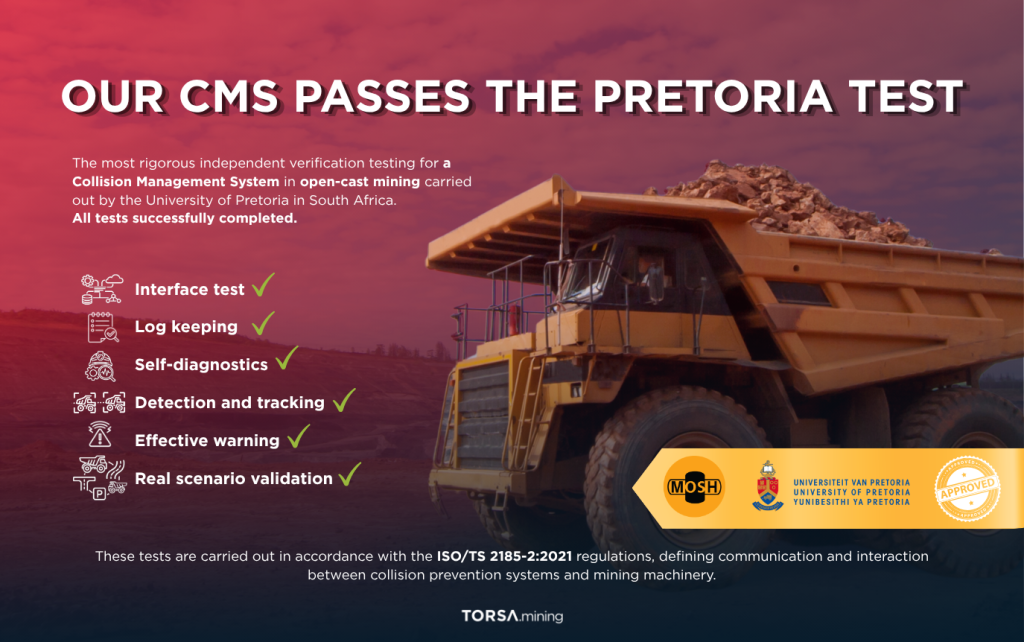
TORSA has become the second company worldwide to successfully pass the TRL4 (Technology Readiness Level 4) Surface Collision Warning and Avoidance Device (CxD) tests carried out by the University of Pretoria in South Africa.
This is the most demanding validation process for collision avoidance systems in open-pit mining. These tests are carried out in accordance with ISO/TS 21815-2:2021 regulations, which, together with the specifications published by MOSH (Mining Industry Occupational Safety and Health), define the communication and intervention requirements between collision prevention systems and mining machinery. TORSA’s CMS successfully passed all the tests in each of the assessed blocks.
In this context, the system passed each of the tests under strict criteria and with minimal margins of error. The objective is not only to detect potential risks, but to do so with maximum precision, intervening only when necessary, avoiding false alerts that could compromise operations and without affecting productivity. Achieving this balance is one of the major challenges of the validation process.
A validation process with no margin for error.
These tests are divided into two phases: simulation and real-life intervention. The first consists of a series of tests in which the CMS must verify compliance with the ISO standard. The level of demand is extremely high: even a deviation in response time may result in a penalty.
Once the simulator tests have been completed, field tests are carried out with real vehicles and real-life scenarios, including:
- Parking manoeuvres: in an environment with up to six surrounding vehicles, the system must intervene with precision to avoid triggering false alerts that could distract the operator while manoeuvring.
- Driving in speed-limited areas of up to 40 km/h: the system must be able to limit the vehicle’s speed within the geofence.
- Restricted areas (no-go zones): the system must be able to prevent the vehicle from entering a defined restricted area.
- Curved and straight crossings: the system must accurately detect other vehicles, avoiding false alerts that could affect productivity.
- Intersections: the system must recognise and manage priority when other vehicles approach.
The complexity of this process lies in the fact that ISO/TS 21815-2:2021 does not evaluate the system as a black box, but requires each of the CMS’s critical subsystems to be validated independently. This approach makes the certification one of the most rigorous technical validations in the sector.
Two main challenges defined the execution of the tests. The first was to demonstrate that the system can identify both moving and static objects with the precision required to generate relevant and actionable alerts under any circumstance and environmental condition. This challenge was addressed through the combination of several sensor technologies, including high-accuracy GPS. The second major challenge was defining the braking intervention in such a way that operator safety is preserved while also protecting the vehicle’s mechanical components, avoiding damage to the suspension, brakes and tyres, as well as excessive stress on the operator. In this way, the system helps avoid increasing the operation’s maintenance costs, contributing to productivity without compromising safety.
After overcoming all the technical and technological tests and challenges, TORSA’s CMS joins a very limited group of solutions that have achieved this level of certification, becoming the second in the world to do so.
Greater safety, higher productivity.
When an intervention technology such as the CMS is implemented in a mine to mitigate one of the main risk factors, such as vehicle-to-vehicle interaction, it not only increases operational safety but also strengthens operational continuity. In addition, TORSA’s work on braking intervention has been developed to minimise excessive wear on key vehicle components, such as shock absorbers, brake pads and tyres. These improvements have a positive impact on productivity and on the reduction of incidents, helping to minimise unplanned downtime, costly interruptions and serious accidents.
The fact that all six blocks — interface, system log, self-diagnostics, detection, alert and controller — have been independently accepted makes this certification a true engineering validation, rather than a simple documentary procedure. Behind this achievement are years of work by a team that has successfully responded to one of the most demanding technical standards in the industry. The next step will be to carry out the TRL7 and TRL9 tests and demonstrate the same level of performance in real mining operations, where the technology confirms its true purpose every day: contributing to safer and more efficient operations.